Tigard Wine Cellars · Services

Wine Cellar Cooling Systems in Tigard

Tigard Wine Cellars specifies and fits refrigeration for wine cellars in Tigard, from a new glass room to an older cellar whose unit can no longer keep pace. Cellar equipment is designed to hold roughly 55°F and, as CellarPro describes its units, to cool gently without stripping moisture from the air. The right kind for a room comes down to two things: how much heat it gains and where the unit can reject that heat.

Cooling installations extend to Durham, Tualatin, King City, Metzger and Bull Mountain. We handle cooling as part of a cellar design and installation rather than selling boxed equipment.

Request a cooling system quote

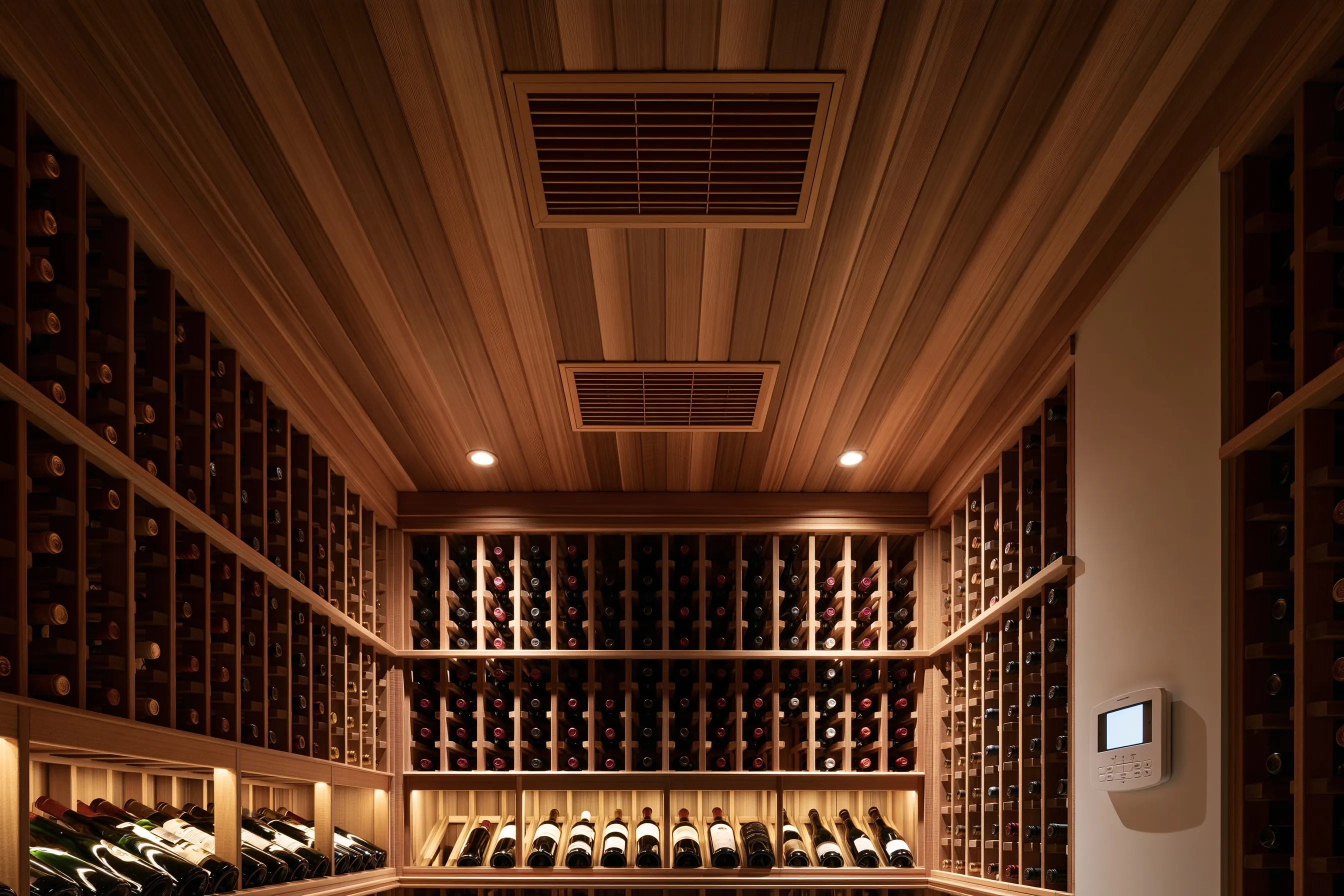
Cellar with a slatted wood ceiling holding two ducted air grilles above wood individual-bottle racking, a digital controller on the wall

Wine cellar cooling system options

Self-contained through-wall units

One box mounted through a wall, cold face toward the bottles and warm face toward the next room. CellarPro wants that room to match or exceed the cellar’s volume and leaves 8 inches free behind the unit. WhisperKOOL’s XLT units manage up to a 30°F drop, so the room receiving the exhaust cannot run hotter than 85°F if the cellar is to stay at 55°F.

Ducted self-contained units

Picture the machine one room away: a ducted self-contained unit lives in an attic or utility space beside the cellar and breathes through two ducts, so the cellar shows nothing but grilles. An attic above a single-story wing is one candidate spot. WhisperKOOL rates its Phantom to hold 55°F while the exhaust area sits anywhere between 42°F and 110°F.

Split systems

Splits separate the cold half from the hot half. Inside the cellar hangs an evaporator; outside, perhaps along a side yard, sits the condensing unit, with a refrigerant line set between. WhisperKOOL accepts installation of its splits only by a certified HVAC-R technician, and under EPA’s Section 608 rules, adding or removing refrigerant or attaching lines during installation takes a certified technician.

Ducted split systems

Move the evaporator out as well and the cellar hears nothing: cold air arrives through ducts while the condenser runs outdoors. Wine Guardian says this ducted split layout is ideal for glass wine rooms whose condenser air would otherwise have no easy outlet.

Replacing or upgrading an existing unit

A struggling unit can point to the room rather than the machine. CellarPro links poor sealing to excess condensation inside its units and water leaks, and Wine Guardian links a weak vapor barrier to heavy flow at the drain, so door gaskets, vapor retarder and insulation are checked before anyone sizes up.

Sizing and heat load

Sizing starts with volume, but CellarPro states that glass, uninsulated walls or a missing vapor barrier make the load much higher than its tables show and call for a custom calculation. Breezaire’s chart, for instance, rates its WKL 2200 at 265 cubic feet only for rooms built to its insulation minimums.

Climate sets the outside condition. The NOAA Beaverton 2 SSW station near Tigard logs about 349 cooling degree days a year, a mild total, yet afternoons reach 90°F or more about 15 days a year, and equipment is chosen for those afternoons.

Why not a home AC or mini-split

Ask a comfort system to hold a cellar and two things go wrong: temperature and moisture. Wine Guardian, which sells cellar equipment, says household mini-splits are built around roughly 72°F, rarely get to 55–58°F and are designed to keep humidity at 50% or below. Window units do worse by Wine Spectator’s account, typically bottoming out near 62°F and drying the room to about 35%, enough to crack or crumble corks.

Electrical, drains and permits

No single circuit fits all. In the manuals reviewed for this page, CellarPro’s 1800 series needs its own 15-amp circuit, WhisperKOOL’s Phantom its own 20-amp circuit, and WhisperKOOL’s ceiling-mount split two separate dedicated circuits, one per component. What protection the receptacle needs is an electrician’s call, made from the manual and the electrical code that applies.

Water from the coil has to go somewhere. WhisperKOOL makes a drain line compulsory for both the Phantom and its ceiling-mount evaporator. Wine Guardian’s ducted split manual specifies drain tubing no narrower than 1/2 inch inside diameter running to an external drain, and its optional condensate pump takes a separate outlet.

In Oregon, installing new permanent wiring needs an electrical permit, and the Building Codes Division’s homeowner guidance does not mention refrigeration equipment specifically. Inside Tigard city limits the Building Division issues electrical and mechanical permits, so the permit set for a particular system is confirmed with the city before installation.
Cooling a display cellar in Tigard

Display cellars, the wine walls and glass rooms this site leads with, are demanding to cool. Glass adds heat, living-space locations leave nowhere hidden for a noisy unit, and nearby Beaverton weather stations record 90°F or more about 15 days a year. A split or ducted split with the condenser outdoors, shaded from afternoon sun, suits that combination; WhisperKOOL says its ceiling-mount split holds 55°F with ambient up to 110°F.

Cooling system questions

Which type of cooling system do I need?

Two facts decide it: the heat load and where heat can go. A suitable ventilated room next door can allow a through-wall unit; without one, ducts or a split system carry heat away. Glass-heavy rooms lean toward a ducted split.

Can I use a regular mini-split?

It is no replacement for cellar equipment. Comfort mini-splits hold warmer temperatures and pull more moisture from the air than a wine room can tolerate.

Does a cooling unit need its own circuit?

Both makers whose units this page cites, CellarPro and WhisperKOOL, call for a dedicated circuit. The exact circuit and its protection for your model are confirmed by your electrician.

Request a wine cellar cooling quote

Send the cellar’s rough size and how much glass it has, then tell us what is on the other side of each wall or ceiling (a garage, an attic, the outdoors) and whether a unit is already installed. Add the address in Tigard or nearby. We'll get back to you soon with an estimate or any questions we have. Estimates are free and there's no obligation.

Call (971) 387-0516

Call (971) 387-0516