Under-Stair Wine Cellars in Tigard

Typical cost in Tigard

  • Open racks under the stairs, no cooling, about 100 to 200 bottles$2,800 – $7,700+
  • Enclosed and cooled, glass front, about 150 to 300 bottles$11,000 – $27,500+

A staircase leaves a sloping void underneath, and that void can become a wine cellar. We make it insulated, refrigerated storage, closed off by a glass front or a solid insulated door. Every face of it, from the underside of the treads to the side walls and the floor, is insulated and sealed like the rest of the cellar.

We also build them in Tualatin, Durham, Metzger, King City and Bull Mountain. Where a staircase rises from the entry or a great room, a lit glass front makes the cellar a feature.

Request a free quote

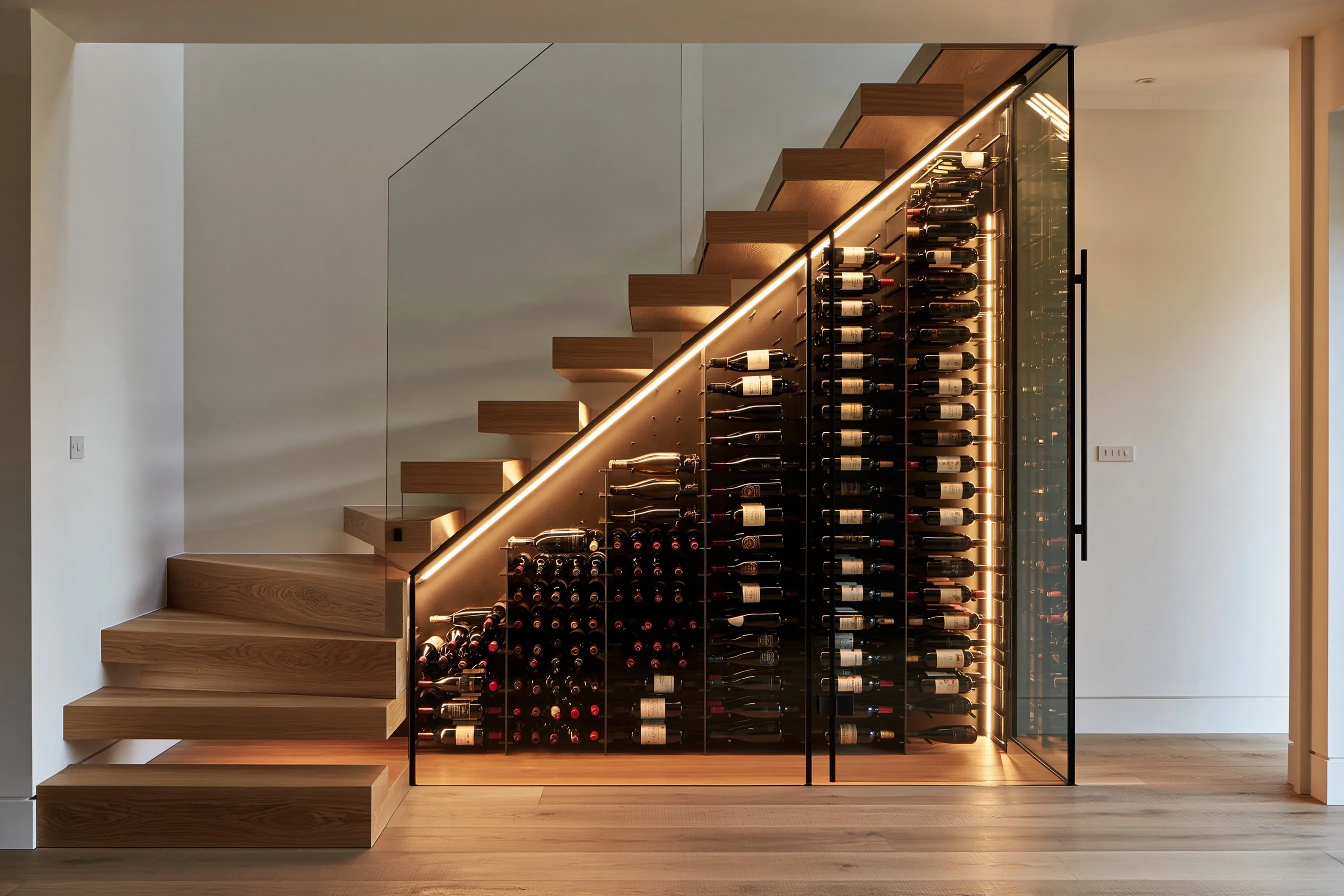
Floating oak staircase with a glass-enclosed wine cellar beneath it, bottles on metal pegs stepping up with the stair slope and an LED strip along the stringer

Under-stair wine cellar options

Glass-fronted under-stair cellars

Insulated panels trace the stair line and a glass door opens the cellar, putting the bottles on show where the staircase lands. Glazing here follows the same logic as a full glass room: low-E insulated units, gasketed frames and equipment sized for the extra heat.

Enclosed under-stair wine rooms

A deep enough void can hold a small room you step into, closed by a framed wall and an insulated exterior-grade door. Overhead, the treads become the cellar ceiling, and ceilings need the most insulation, with the cooling makers asking for R-19.

Racking that follows the stair slope

Stepped racking tracks the stringer: tall columns where headroom allows, shorter runs as it drops, and bins tucked into the lowest corner, where standing racks will not fit but magnums and cases will.

Open stairs vs closed stairs

Open-riser and floating stairs leave gaps between treads, and every gap is an air leak. With an open design the cellar is built as its own sealed box beneath the treads; a closed stair already has a solid underside that can be insulated and sealed.

Cooling under a staircase

Under a stair, the warm air is the hard part. A through-wall unit needs a neighboring room at least as big as the cellar, and closets, garages and unventilated laundry rooms do not qualify. Often the answer is ducting or a remote unit, and a ducted system can sit down in the basement.

Permits for new walls and circuits

Adding, moving or removing walls needs a building permit. Nonbearing interior walls are exempt unless they create a habitable room, so we check with the permit office whether an enclosure under the stair counts. New permanent wiring for cooling or lighting needs an electrical permit either way. Inside city limits the City of Tigard Building Division issues these permits; Tigard Maps shows whether an address is inside the city.

Glass-fronted stair cellars in Tigard’s newer homes

Nearly three in ten Tigard homes were built in 2000 or later, and a staircase rising from an entry or great room is a visible spot for a glass cellar. Floating treads and glass rails look good above one, but they need the most sealing beneath, because the cellar cannot rely on the stair itself for a seal.

Under-stair cellar questions

Where does the cooling unit exhaust under a staircase?

Somewhere with enough air: a ventilated neighboring room at least as big as the cellar, ductwork to an attic or utility space, or a split system’s outdoor condenser.

Does an under-stair cellar need cooling?

For wine you plan to age, yes. Without cooling the space follows house temperature, and temperature swings stress the corks and can let air into the wine.

Can it be glass?

Glass works well here. A sealed glass door and insulated panels make the stair cellar a display, and we choose the cooling with that glass counted.

Request a free wine cellar quote

Say whether the staircase is open or closed underneath and what lies behind it. Add the number of bottles you have in mind and the address. We'll get back to you soon with an estimate or any questions we have. Estimates are free and there's no obligation.

Call (971) 387-0516

Call (971) 387-0516