Tigard Wine Cellars · Services

Glass Wine Rooms in Tigard

Tigard Wine Cellars designs glass wine rooms for Tigard homes, meaning walk-in cellars glazed with insulated glass on one or more sides, so the collection is seen from the living or dining room while it stays at cellar temperature. The glass gets the attention, yet much of the work is in what surrounds it: an insulated ceiling and solid walls, sealed frames and a cooling system sized for the heat the panes let in.

We design glass rooms for homeowners in Bull Mountain, King City, Metzger, Durham and Tualatin as well, planned as a feature off a great room rather than storage tucked out of sight.

Request a glass wine room quote

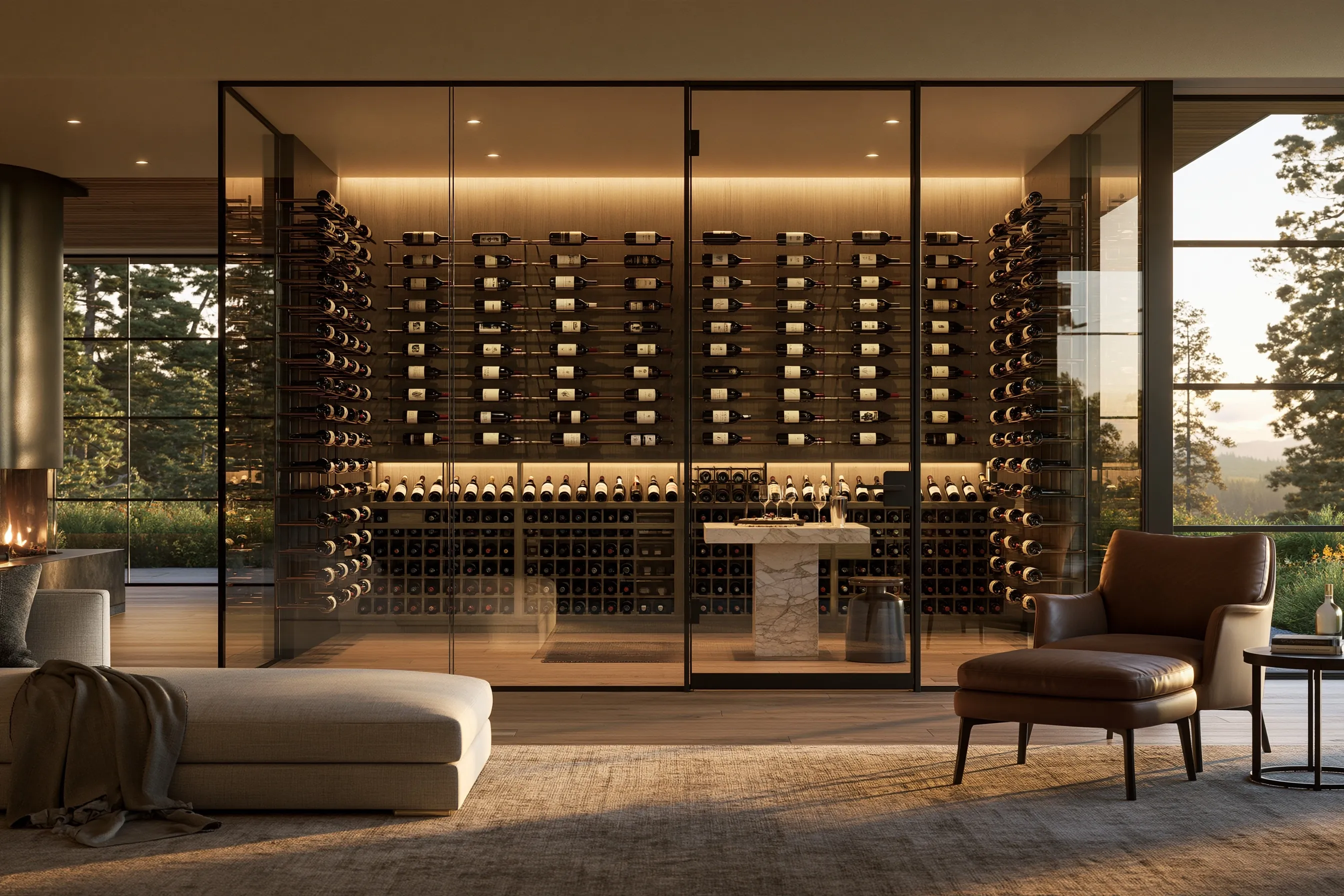
Walk-in wine room with full-height glass walls, bottles on metal rods along three sides and a marble tasting plinth, opening off a living room with a leather armchair

Glass wine room options

Walk-in glass wine rooms

A dedicated room with a glass front, or glass on two or three sides, opening off a main living space. Wherever the room is not glass, the ceiling, solid walls and floor carry full insulation and a warm-side vapor retarder, because those surfaces have to make up for what the panes give away.

Glass fronts on an existing room

A framed space such as a den or a room off the dining area can take a glass wall and door on its visible side while the other walls are insulated and sealed as a conventional cellar. That keeps the glazed area, and the extra heat load, to the side people actually see.

Framed vs frameless insulated glazing

Compare the numbers before choosing glass. In CellarPro’s R-value table a single pane rates R-0.91 while a low-E double pane with a half-inch air space reaches R-3.13, which makes insulated low-E units the starting point for a cooled room. A Wine Guardian dealer says framed systems accept true insulated units and seal more reliably, whereas frameless walls use 3/8 to 1/2 inch tempered or laminated glass for an uninterrupted look.

Glass doors and seals

A loose door undoes good glass. Wine Guardian’s recipe for an airtight glass room combines insulated double-pane glazing with exterior-grade doors and thresholds; in practice that is a glass door in a weatherstripped frame rather than a frameless panel with gaps at its edges.

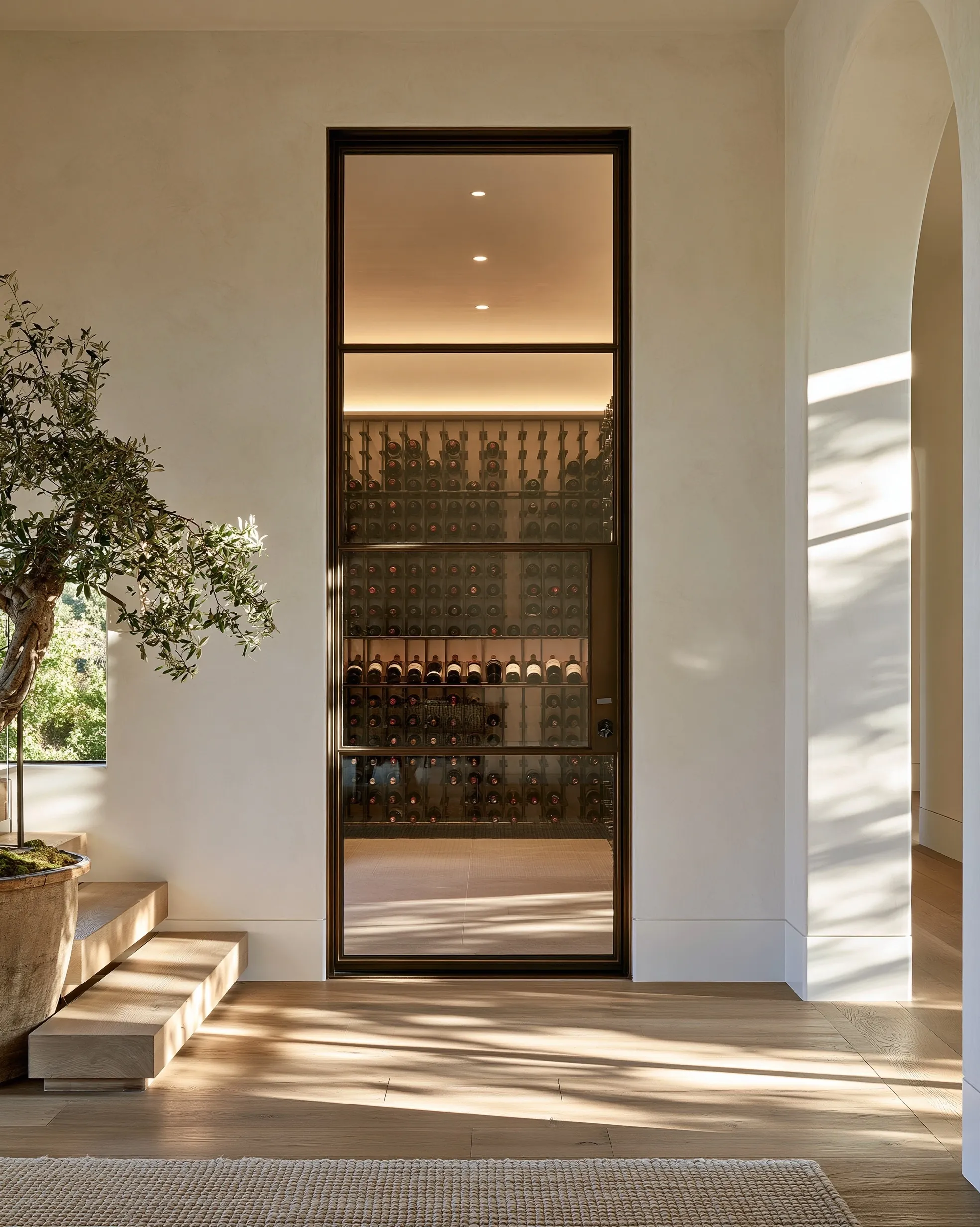
Tall bronze-framed glass cellar door in a plaster wall showing lit racking inside, beside an olive tree on a sunlit oak floor

Condensation and dew point

Guardian Glass, a glass manufacturer, explains that condensation appears when a pane’s surface is no warmer than the dew point of the adjacent air. In a wine room the cold face is inside, so trouble would show on the living-room side. Hourly NOAA normals at Portland-Hillsboro airport give a mean outdoor summer dew point close to 53°F, a hair under a 55°F cellar, so single glazing held at cellar temperature would be marginal; insulated units keep the outer pane comfortably warmer.

Cooling a glass room

Glass raises the heat load, and equipment makers do not agree on the response. Breezaire’s position is that cooled enclosures should not contain glass doors or windows, and its sizing ignores glass. WhisperKOOL accepts glass doors but recommends moving up one unit size if the room is close to its rating. CellarPro wants a custom heat-load calculation instead of its charts. For glass rooms that are hard to vent, Wine Guardian points to ducted split systems.

Lighting inside glass

A glass room is meant to be seen, so it is lit more than a closed cellar. The Wine Guardian dealer notes that LED strips add little heat, and the 2026 OENO One study found yellow-filtered LED far gentler on wine than cool-white light. Recessed ceiling cans are worth avoiding because they open the ceiling to warm air.

Glass wine rooms on display in Tigard

Put a glass cellar in a Tigard great room and it reads as furniture, visible from the island and the couch. Three planning points follow. House windows should not throw late sun on the glass, LED strips count toward the heat load alongside the panes, and the condensing unit belongs outside or in a distant room so nobody hears it. The design condition comes from Beaverton 2 SSW normals: 82.3°F average summer highs and about 15 days a year at 90°F or more.

Permits for a glass room

A new glass room involves framing, insulation and wiring. Inside Tigard city limits the Building Division issues interior remodel permits and the electrical and mechanical trade permits; for unincorporated addresses outside them, check Washington County’s own requirements.
Glass wine room questions

Will the glass fog up?

Fogging is unlikely with insulated low-E glazing and a sealed room. It happens when a glass surface drops to the dew point of the air beside it; insulated glass keeps the room-side pane warmer, and an airtight door keeps humid house air out of the cellar side.

Can a glass wine room hold cellar temperature?

Yes, provided the equipment is selected with the glass counted. Panes add heat, so the unit comes from a heat-load calculation instead of a cubic-foot chart, and a ducted split keeps the condenser out of earshot.

Framed or frameless glass?

Framed glazing carries real insulated units and closes up tightly. Frameless glass looks lighter but depends on thick single panels, so it asks more of the cooling. Decide how much extra capacity you are happy to run, and the choice follows.

Request a glass wine room quote

Which space would the glazing open onto, and roughly what share of that wall? A bottle count and the address help too. We'll get back to you soon with an estimate or any questions we have. Estimates are free and there's no obligation.

Call (971) 387-0516

Call (971) 387-0516